
Mass Engineered Timber (MET)
MET offers sustainable construction solutions with good strength-to-weight ratios and can be prefabricated with precision in controlled factory environments. Using MET can lead to faster construction times and reduced carbon footprint. Projects considering use of MET should pay attention to fire safety requirements, moisture protection, and connection details specific to timber construction.
Last updated 16 March 2026
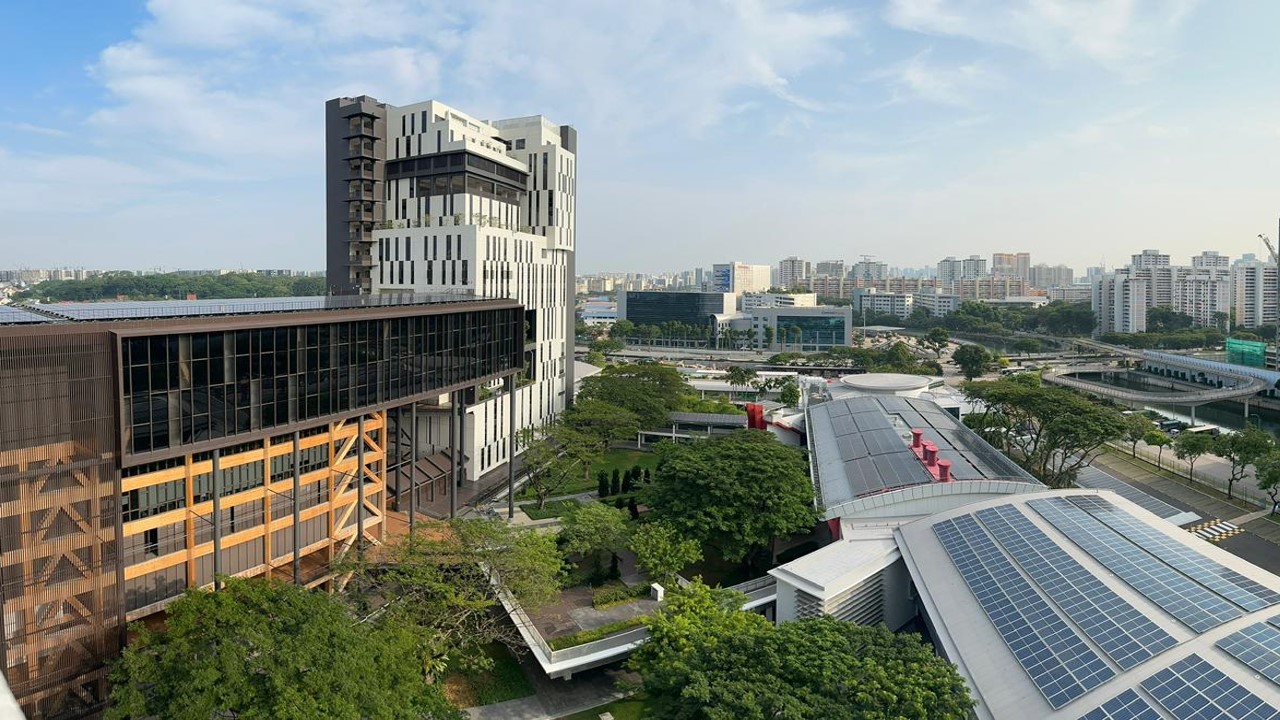
BCA Academy 7-storey Zero Energy Building built using MET
What is MET
Mass Engineered Timber (MET) is a building material comprising engineered wood products with improved structural integrity. This includes:
Cross Laminated Timber (CLT) – Layers of wood are stacked cross-wise and bonded with structural adhesives. It is predominantly used for walls, floors and roofs.
Glued Laminated Timber (Glulam) – Produced in a similar fashion but with the grain aligned in the same direction. It is predominantly used for columns, beams and truss elements.
Why use MET
Improved productivity – As MET is prefabricated off site, it can achieve up to 35% time savings at the project level.
Better construction environment – Less dust and noise as most work is completed off site.
Improved quality control – Highly precise and automated manufacturing processes result in high quality finishing.
Environmental sustainability – MET is harvested from sustainably managed forests, and MET buildings have a lower carbon footprint and net carbon emissions compared to steel or concrete buildings.
What to consider when using MET
Early contractor involvement – Developers/project managers should engage the MET specialist and main contractor during the design stage of the project. This way, the specialist can communicate their recommendations to the main contractor before actual construction begins.
Site/project management – Time and manpower savings can be gained from good site and project management. This includes adopting best practices for shipping, transportation, delivery, storage, protection, lifting and handling, and site installation.
Maintenance, replacement, and refurbishment – Regular maintenance checks are required for all buildings during their operational lifespan. For MET buildings, building owners should engage a Professional Engineer (PE) to check on areas such as moisture content, end grain, insect and fungi attack, UV treatment, corrosion, significant cracks, delamination and warpage, and deflection (for long span structures of more than 20m). For any replacement or renovation works, a Qualified Person should be consulted prior to commencement.
Compliance with Regulations and Acceptable Solutions in Singapore
Prevailing Building Control Regulations – All buildings and structures must comply with the objectives and performance requirements set out in the prevailing Building Control Regulations and Approved Document under the Building Control Act.
SCDF fire safety requirements – Timber buildings (similar to reinforced concrete or steel buildings) are to comply with the SCDF’s fire safety requirements.
Resources
MET Case Study – Woh Hup Technical Hub [PDF, 487 KB]
The Woh Hup Technical Hub is a 4-storey office building in Singapore constructed using Mass Engineered Timber (MET), Prefabricated Prefinished Volumetric Construction (PPVC), and structural steel. Featuring glulam columns, beams, and CLT floor slabs, the project achieved over 20% productivity gains with lightweight, fast-install MET components, enhancing acoustic performance and sustainability.
MET Case Study – Eunoia Junior College [PDF, 488 KB]
Eunoia Junior College is Singapore’s first high-rise school built with Mass Engineered Timber (MET). Featuring CLT façades and hybrid CREE slabs, the project achieved over 30% productivity gains through prefabrication and lightweight materials, enhancing structural efficiency, fire safety, and sustainability in high-rise educational construction.