
Prefabricated Mechanical Electrical and Plumbing (MEP) System
Prefabricated Mechanical, Electrical & Plumbing (Prefab MEP) systems are MEP components and equipment that are integrated into a sub-assembly off site and then transported to the site for installation.
Last updated 4 March 2026
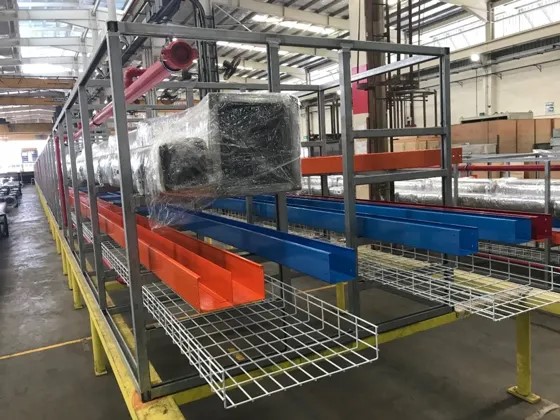
Prefabricated sub-assemblies (Photo Courtesy of Gammon Pte. Ltd)
Why use Prefab MEP systems
Increased construction productivity – Using Prefab MEP systems can achieve time savings of up to 60%.
Improved workplace safety – As most works are done off site, the time spent working in non-conducive on-site conditions (at height or in confined spaces) is significantly reduced.
Improved environmental performance – Dust and noise pollution are minimised on site.
Higher quality control and quality assurance – Improved quality of MEP assemblies as the components and equipment are assembled in a controlled factory environment.
What to consider when using Prefab MEP
Identification of areas suitable for prefabrication – Project stakeholders should come together to identify areas within the development that are suitable for prefabrication. Adopting Prefab MEP in areas with a higher density of MEP services (e.g. near service cores, near MEP plants) will yield higher productivity gains.
Early involvement of contractors and MEP specialists – The early involvement of contractors and specialists in the coordination of MEP services enables more time for optimising service distribution.
Site/project management – As the modules of Prefab MEP systems can be bulky and heavy, the project team should plan for suitable delivery routes and lifting equipment right from the start. Adopting a Just-in-Time (JIT) approach to module delivery will facilitate efficient installation and reduce on-site congestion.
Maintenance, replacement and renovation – The maintenance of Prefab MEP installations will not vary much compared to the conventional MEP installations. Basic maintenance considerations (e.g. location & orientation of valves, working space for maintenance activities) will need to be incorporated into the design before the modules are fabricated.
Compliance to Regulations
Code of Practice – The installation of Prefab MEP systems must comply with the Code of Practice relevant to each system. Project stakeholders are reminded to ensure such compliance, and any deviations should be brought up, discussed, and approved by the relevant authority prior to work being done.
Types of Prefab MEP systems
Prefab MEP systems are made up of smaller subassemblies of MEP modules and components such as ventilation ducts, pipe sections, electrical panels, and plant modules.
Examples of Prefab MEP systems include horizontal modules, vertical modules, and plant modules:
Horizontal Modules – prefab modules at all circulation areas (such as corridors and lift lobbies) where common M&E services will run, e.g. assemblies of ceiling modules with air-conditioning ducts and water pipes.
Vertical Modules – prefab modules within risers, e.g. electrical risers, chilled water risers, fire protection hosereel risers.
Plant Modules – modules for pumps or equipment, e.g. plumbing and sanitary pumps, fire protection system pumps, chilled water and condenser water pumps.
Prefab MEP Manufacturer Accreditation Scheme (MAS)
The Prefab MEP MAS ensures quality assurance and control in the design, production, and installation of PMEP modules. The scheme is managed by the Specialist Trade Alliance of Singapore (STAS) with an accreditation criteria jointly developed with BCA. The scheme also features a two-tier framework to recognise firms which achieve advanced levels of automation and digitalisation.
Case Studies on PMEP
Prefab MEP Case Study – Global Switch Singapore Woodlands Data Centre [PDF, 800 KB]
The Global Switch Singapore Woodlands Data Centre was Singapore's first large-scale project to adopt Prefab MEP systems, deploying approximately 350 modules. This approach delivered higher quality control, manpower savings, improved safety standards, and reduced construction time by over 10%.