Green Buildings Innovation Cluster (GBIC) Programme
Set up in 2014, the Green Buildings Innovation Cluster (GBIC) is an integrated research, development and demonstration (RD&D) programme that aims to accelerate the development and deployment of promising energy efficient technologies in buildings.
Last updated 14 March 2026
Key Objectives
Serving as a one-stop integrated RD&D hub to experiment, exhibit and exchange knowledge of promising building energy efficient solutions with industry stakeholders
Coordinating and disseminating building energy efficiency related activities and data
In consultation with stakeholders, the Built Environment Decarbonisation Technology Roadmap was developed to identify key technologies and provide strategic planning for the GBIC programme.
GBIC 2.0 Programme
To further push the boundaries of energy efficiency to support Singapore Green Building Masterplan (SGBMP), an enhanced Green Buildings Innovation Cluster programme, named GBIC 2.0, was rolled out in March 2022.
This programme will build on the success of the current GBIC, intensifying the support for needle-moving technologies with deep energy efficiency.
GBIC 2.0 Initiatives
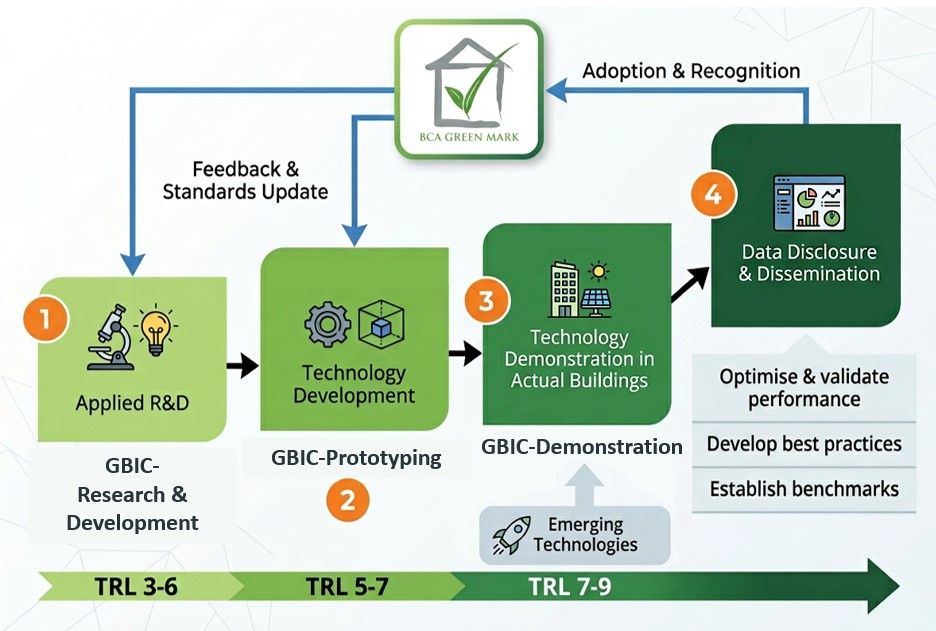
GBIC 2.0 has four key initiatives that focus on green building RD&D with translation:
Funding Schemes
For enquiries, please contact: BCA_GBIC@bca.gov.sg.
GBIC Research & Development (GBIC R&D)
GBIC R&D aims to collaborate with the local and international R&D community, and industry stakeholders to develop innovative solutions to improve building energy efficiency.
Eligibility for GBIC R&D scheme
- | R&D |
|---|---|
Intent | Support development of high impact solution to be ready for piloting upon completion. |
Target Group | Solution provider from private sector* or research institute as lead with building owner/developer as sponsor/adopter. |
Technology Readiness Level | Start TRL: 3 End TRL: 7-8 |
Funding | Up to 70% for private sector*, 100% for IHL/RI Funding size to be reviewed on a case-by-case basis. |
Project Duration | Up to two years |
Desired Outcomes |
|
*Funding for private entities for R&D projects of total project budget >$0.5M would be conditional on collaboration with a public research performer.
GBIC Product Prototyping (GBIC PP)
This provides a platform for 'out-of-lab' research outcomes to be refined and customised for actual building application and to support promising solutions from local/overseas companies for further development and adoption in our local environment.
In addition, it aims to encourage building owners, consultants and stakeholders to adopt a more holistic approach to strive for greater energy efficiency at an early design stage of the building project.
Eligibility for GBIC Product Prototyping scheme
- | Product Prototyping |
|---|---|
Intent | Support refinement of innovation to be ready for piloting upon completion. |
Target Group | Solution provider from private sector* as lead with research institute as collaborator, building owner/developer as sponsor/adopter. |
Technology Readiness Level | Start TRL: 5 End TRL: 8 |
Funding | Up to 70% for private sector*, 100% for IHL/RI Cap at S$500,000 per project. |
Project Duration | Up to one year |
Desired Outcomes |
|
*Funding for private entities for Product Prototyping projects of total project budget >$2M would be conditional on collaboration with a public research performer.
GBIC Demonstration (GBIC Demo)
The GBIC-Demo provides building owners and developers the opportunity to strive for greater energy savings by demonstrating innovative energy efficient technologies that have not been widely implemented locally in upcoming projects or existing buildings.
The programme brings together building owners/developers with research performers, technology providers and system integrators to establish platforms where industry can test and showcase these technologies and generate local performance data for verification by a 3rd party.
To find out more about success stories on Demonstration projects, please visit SLEB Smart Hub.
Eligibility for GBIC Demo scheme
- | Demonstration |
|---|---|
Intent | To encourage building owners/developers to demonstrate innovative energy efficient technologies and solutions to achieve best-in-class building energy efficiency improvement |
Target Group | Building owners/developers. Note: Proposals from consortiums led by ESD Consultants together with technology and solution providers are required for submission of GBIC-Demo applications. |
Technology Readiness Level | Start TRL: 7 End TRL: 9 |
Funding | Up to 70% depending on the profile of the entities, capped at S$3 million. |
Desired Outcomes | 1) Energy Efficiency Improvement 75% building energy efficiency improvement from 2005 levels based on Energy Use Index (EUI), kWh/m²/year. 2) Solutions Open to local and overseas technology companies with the following criteria:
|
Evaluation Criteria
The proposal will be evaluated based on the following criteria:
*Subjected to changes based on challenge calls
Information on the proposal evaluation criteria
Criteria | Description |
|---|---|
a) Alignment with policy intent: |
|
b) Scalability |
|
c) Commercial viability & cost |
|
d) Novelty and Innovation |
|
Funding Support
a) For companies and company-affiliated research entities
Qualify for up to 70% of the approved qualifying direct costs of a project depending on the type of firms (Refer to table below)
b) For Singapore-based IHLs, Research Institutions
Support up to 100% of the approved qualifying direct costs of a project for Singapore-based IHLs, RIs.
Support for indirect costs, in the form of overheads, will only be provided for Singapore-based IHLs.
Information on funding support
S/N | Type | Max Direct Cost support |
|---|---|---|
1 | All non-SG private sector entities (including not-for-profits) | 30% |
2 | LLEs | 50% |
3 | SG SMEs | 70% |
4 | SG Start-ups | |
5 | SG Not-for-profits |
Super Low Energy Building (SLEB) Smart Hub
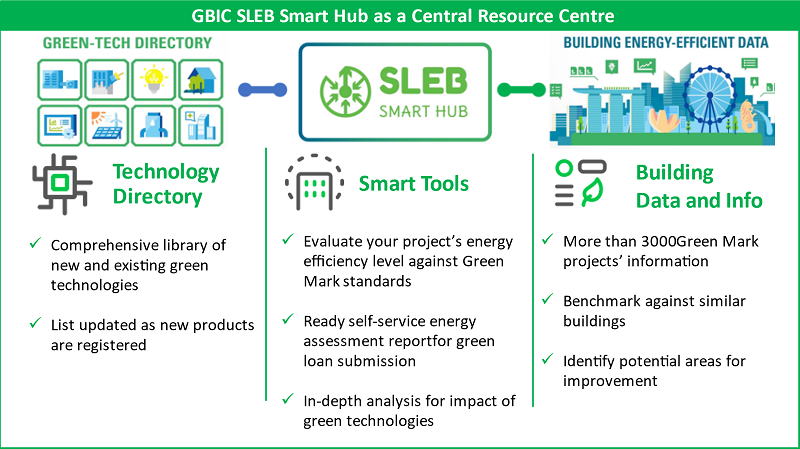
The SLEB Smart Hub is a central resource centre that collects and analyses essential information of GBIC funded projects and data of Green Mark projects and Building Energy Submission System (BESS).
With its abundant data sets and data analytical capabilities, it serves as a one-stop digital service for green building technologies and solutions.